Guild Activities
George and Virginia Siciliano – Visit in May 2010
The Lecture
Yes, this man is nuts! George and Virginia Siciliano’s lecture “This Guy Must Be Nuts” is very funny. While his work is extraordinary, he presents it with a sense of humor. Many of us have seen the results of his workshops at various quilt shows, but to actually see the originals is phenomenal.
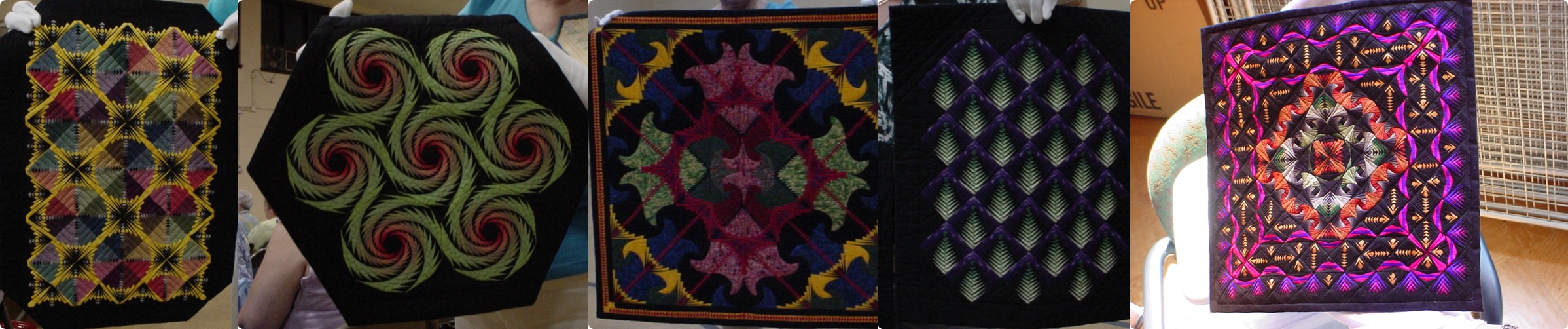
How George got into quilting is a very funny story, but I will not tell it because I would not be able to do it justice. If you missed his lecture, make sure you see him the next time he’s in the area. George’s lecture is a trunk show of his quilts starting with the first quilt he made through to his latest. He talks about his experiences both good and bad in his life of quilting. I loved his story of how he got roped into becoming a member of his local guild. We guild members can be sneaky.
When George first started quilting, Virginia would hand quilt his quilt tops, but that got old. George explains his initial attempts at machine quilting. His story of using invisible quilting thread is great. His first quilt using it ended up being unquilted after if was bound. It’s was still unquilted at the time of his lecture.
George is a very animated and entertaining lecturer. This evening was a great opportunity to be able to get a close look at his intricate work and see how tiny his pieces really are.
The Workshop
The workshops were held at the Nevin’s Library in Methuen, MA. If you have never been to this library you are in for a treat. The library was built in 1883 by the Nevins family. The architecture is wonderful and when the addition was constructed they took care to keep it in a cohesive style with the original building. The stained glass in the room is original to the building. Carrie Zizza was busy drawing the stained glass to create a quilt from it. I took pictures of it so she could enjoy the class instead. Carrie, I hope to see the resulting quilt soon.
Enough about the library, we had two classes. One on Friday and again on Saturday. George is very patient with his students. He has everyone gather around his machine so he can demonstrate his technique. The ruler George designed (a.k.a George’s Tool) for foundation piecing aides in trimming and lining up the next section to be sewn and is easily used by both right and left handers. He demonstrates how he cuts and stacks each round of logs as he goes along. This makes the assembly go a little quicker. Following George’s instructions we were able to create one of his ultra mini blocks with precision.
George showed us a trick when it comes to assembling the blocks. Instead of using pins, he uses double stick tape. That way he can check to make sure the blocks are lined up and adjust as necessary.

As George is demonstrating the block assembly, Virginia uses an extra-large version of the block to point to the piece George is talking about. With the block being so small it helps to see a large version so you know exactly what George is working on.
All in all this is a great class and lecture. Will I continue with foundation piecing? I’m not sure. I was never a big fan of paper/foundation piecing, but after taking the class I understand the do’s and don’ts a little better.
Thanks George and Virginia.
Click Here for the slide show of Lecture and Workshop
Beth Helfter of EvaPage Designs – Lecture and Workshop April 2010
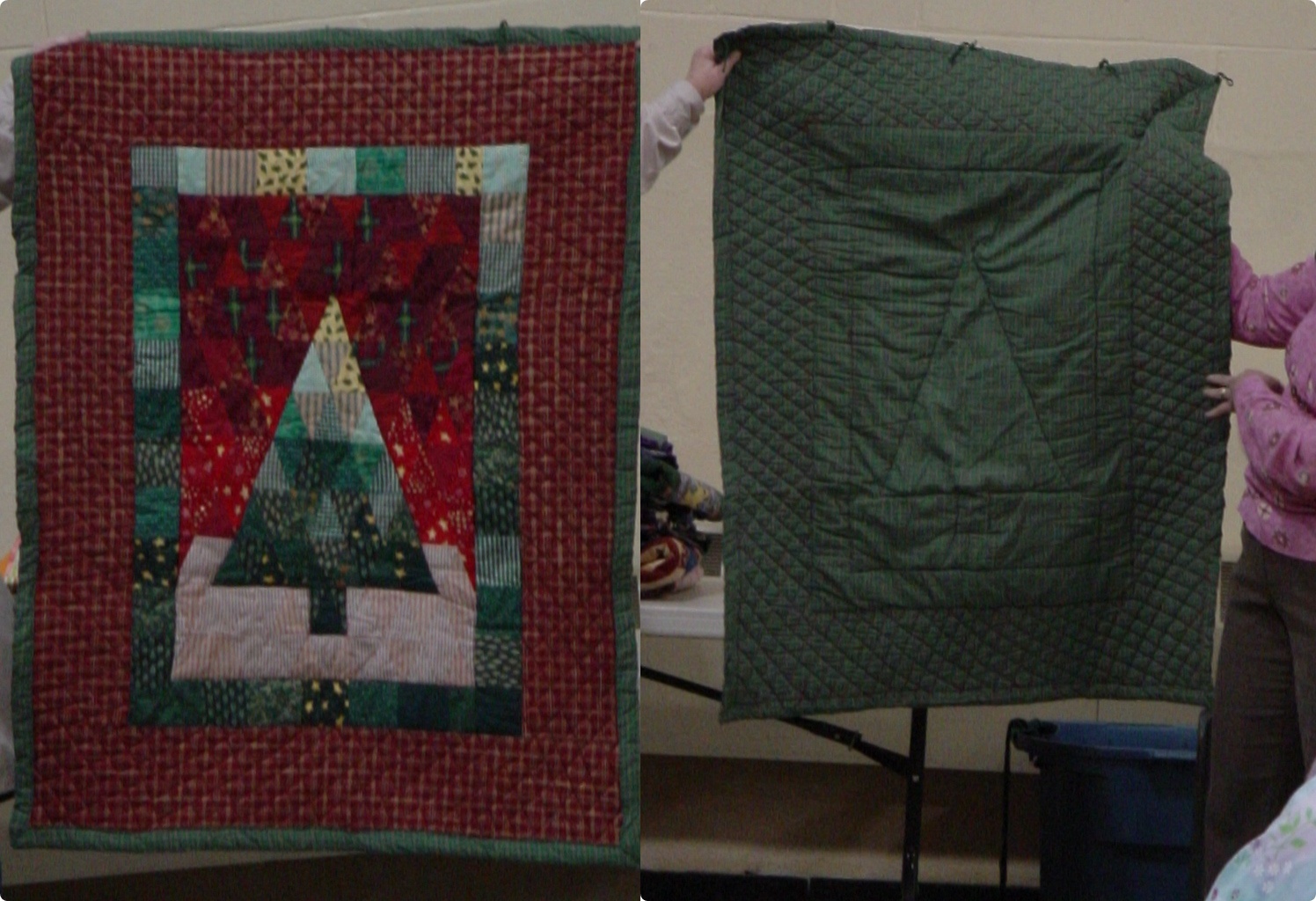 Beth Helfter is a local, hailing from Pepperell, Ma. Her lecture “Perfection Is Overrated” is pretty gutsy. How many of you would stand up in front of a bunch of quilters and parade all your quilting mistakes? Well, Beth does it with flair. It just goes to show beauty is in the eye of the beholder. I, personally, might burn the Christmas Tree, but then again it shows how far she has come in her quilting skills.
Beth has a lot of creativity. I’m not big into applique, but can appreciate that a flower placed in the right position can hide a multitude of sins.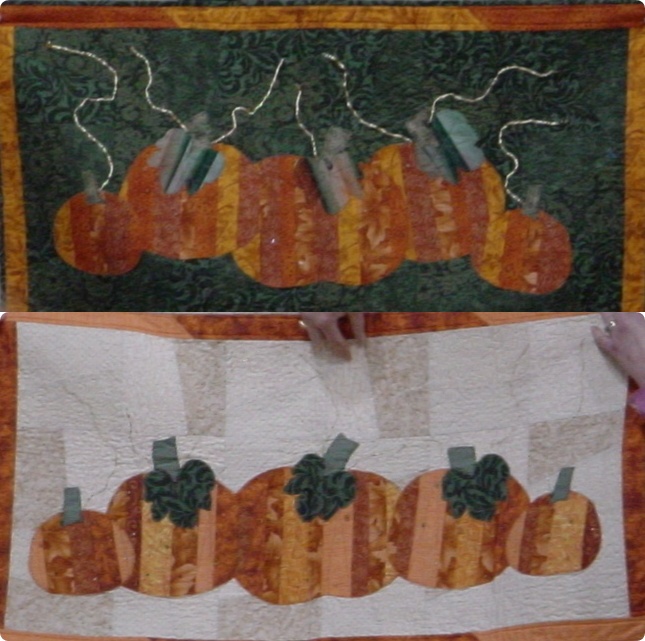
It was great to see what different backgrounds can do for a quilt. I’m not sure if I like the green or beige pumpkins.
 Beth’s princess series is very beautiful. What little girl would not like those quilts on her wall?
The Workshop
The workshop “syncopated ribbons” was enlightening, but a challenge for those who like precision. You start with a block and add random strips of fabric (e.i. ribbons) to each side at odd angles. It’s reminiscent of a crazy block. Once your blocks are done, they are squared up and cut into half square triangles then pieced back together. This really give you a random looking block.
Beth also demonstrated how she assembles her scrappy borders. They are foundation pieced from the excess trimmed off during squaring the blocks. Unfortunately, I was so intent on making my blocks I forgot to take pictures. I did get some of the various colors used in class. I hope to see many at show n’ tell.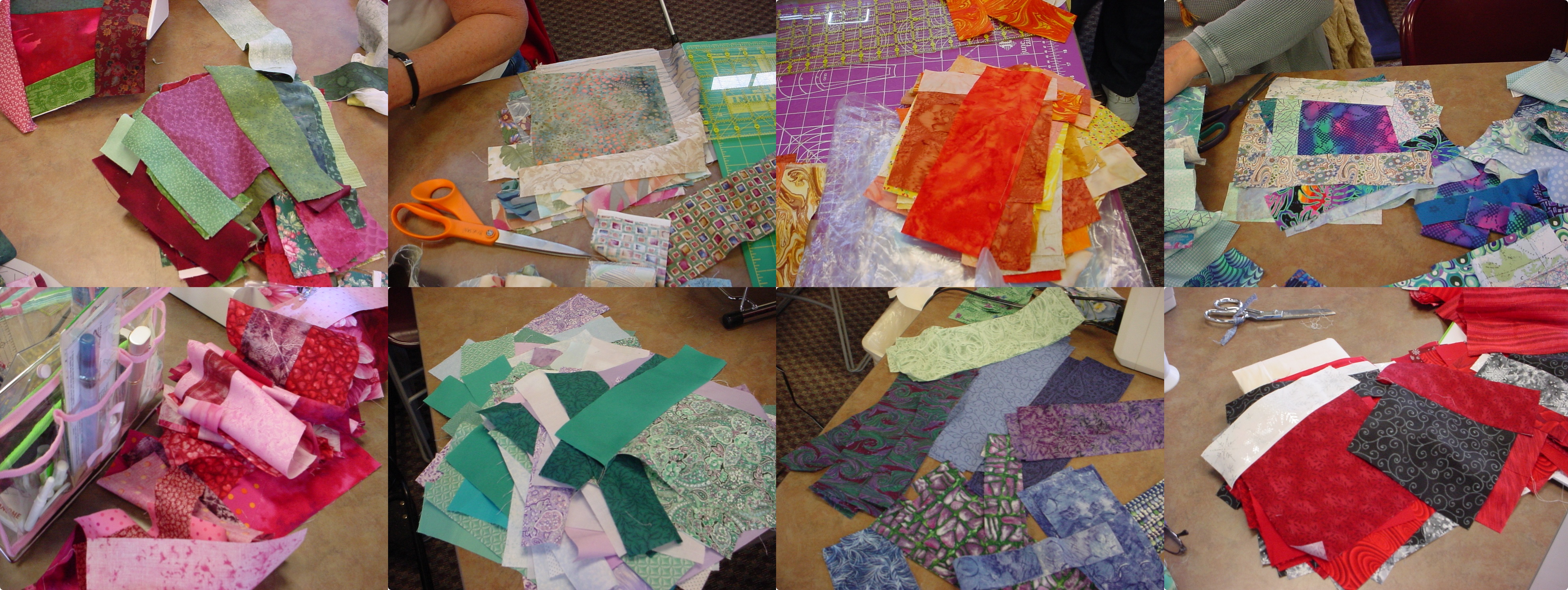
Click Here to see photos from lecture and workshop
30th Anniversary Dinner
The following was submitted by Gail Wozniak.
Thursday, May 6th over 70 women gathered at Maria’s Family Restaurant in Haverhill to celebrate in style, the 30th anniversary of MVQ. We were thrilled to have in attendance Pat Mamacos and Lois Schofield, two of the founding mothers of the guild whose vision and dream of a quilt group for women who love the art of quilting has forged on for thirty years. Flowers were presented to these ladies as well as a plant to Pat Beevers, who although not a Founding Mother, joined the group a month or so into existence. She has been a member all these years and our longest continuing member. It was great to see that many members have been members for over twenty years as we stood to show our years of membership in the guild. Over thirty raffle prizes were won by guests that evening. I think many long time members will attest to what a great group of members we are with all sorts of varying talents in the group and the love of the art of quilting has kept us woven together all these years. I know there are many splinter groups from this large group, some new and just formed and others still meeting weekly after twenty five plus years. And on to number 35!!!
Anne Lainhart – Lecture and Workshop
Anne Lainhart is well known for her bargello classes. After hearing her lecture on color families you can see why. She has an innate sense of color. Her color board is absolutely fabulous. It is a wonderful way to illustrate the complexities of color families. Yet at the same time make them so simple.
The various ways that Anne mixes and matches her color families result in stunning quilts. She tries something just to see if it works. And for her it generally does. At least in my opinion it does. For instance, her multi-color family bargello, most quilters would have never thought to mix the colors in the way she did, but it works.
Anne also works with border prints. She created a Card Trick block using fussy cut border prints. It is simply stunning! It gives you a whole new perspective on border prints.
Click here for Slide Show of Anne’s Work.
Workshop
The workshop was to create a Kaleidoscopic purse. Anne also brought kits for ornaments and note cards. I thought it would be a fun class but I didn’t expect to learn so much. Like when not to press. I know we are taught to cut – sew – then press. But there is a point in which you want to press your kaleidoscope, that is when all 6 or 8 pieces are sewn together and not before. That way you don’t accidentally stretch any of your pieces. Who would have thought of that. Not me, that’s for sure. I got caught going ahead of the teacher and pressing my pieces. That’s me, miss smarty pants. Seems I don’t know everything after all.
Anyway, Anne’s kaleidoscopes are not your average stack and wack. You need to make sure your print has symmetry to it. She demonstrated a few tricks on cutting your border prints using that symmetry. And how to match up the prints before you sew the pieces together. She uses pins, lots of pins. But if you really want to make sure your prints line up you need to pin – pin – pin. 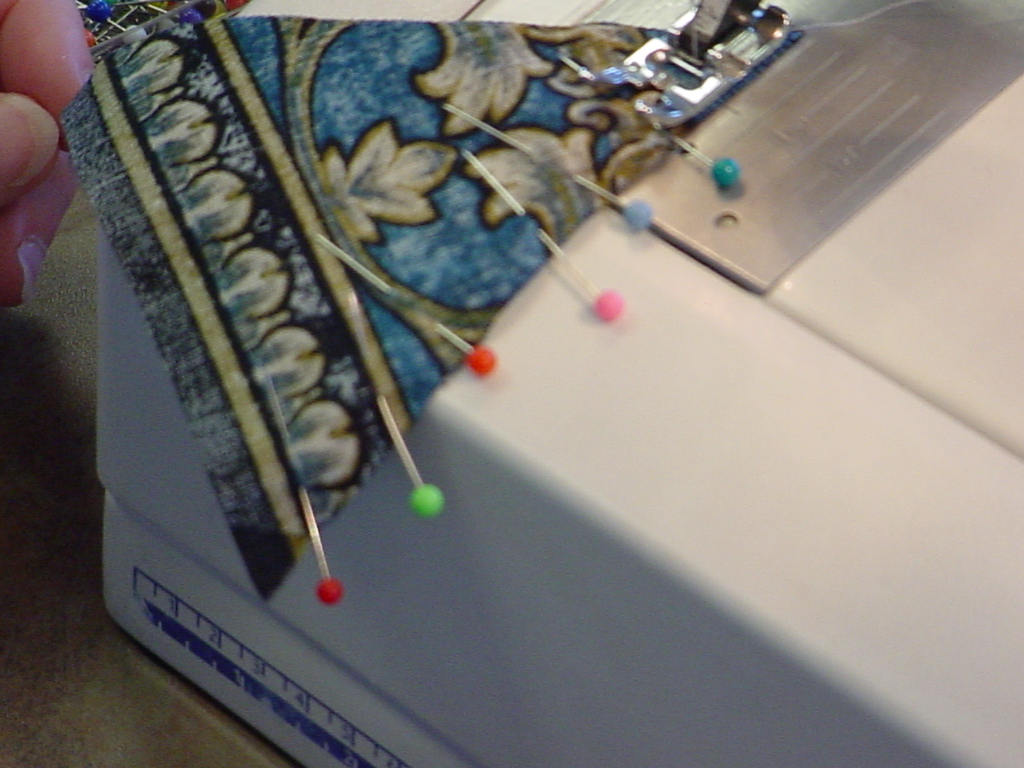 She also demonstrated how to pin the final seam together while matching the print and the center seams. This takes practice to get it right. Mine came out ok but next time I will do better.
In the workshop we got information on cutting and folding note cards. The best way to insert a loop to hang an ornament from. And how best to attach purse handles. You would think this to be all self explanatory but Anne has a few tricks that make you say “Now why didn’t I think of that?”
I am going to keep my eye out for some neat border prints. I’m also going to keep my eye out for more classes taught by Anne.
Thanks for the great class Anne.
Your humble student,
Cathy H
Click Here for a slide show of more workshop photos.
Sarah Ann Smith Lecture and Workshop
Sarah Ann Smith is an art quilter. She makes postcards, journal quilts and art wall hangings. She uses fusing, beading, painting, and any other medium that works for her. Her work is beautiful. View a slide show of her work.
Her lecture on beading showed the varying degree of which beading could be used on quilts, from very minimal to encrusted. She considers herself a minimalist when it comes to beading her quilts. She likes to add just enough beads to give a little sparkle.
Sarah has a group of art quilting friends. Her and her friends help each other grow in their respective art forms. They like to use various mediums withing there quilting. This give each in the group a different way of looking at their own artwork. This group had a showing of some of their work. One of which, they each chose a picture. Then they each had to create a postcard/journal size quilt of all the pictures in the group. It was interesting how different yet similar each were.
The Workshop
The workshop was titled “Postcards: An Introduction to Some New Techniques”. The amount of information we received was incredible. From how to assemble the postcards, to painting, to stamping, to finishing, mailing and displaying your postcards. There was such a wealth of information.
Sarah covered which products she preferred. Peltex 70 is her choice for the stiff stuff used in constructing her post cards. Peltex comes 3 ways, no fusible, one side fusible,or 2 side fusible. She prefers the non fusible. That way she can assemble the design first then fuse it to the peltex. This way you can keep fusing items to the card without over stressing the fusible on the peltex.
As far as fusible web she prefers Misty Fuse. It is a light weight fusible medium. If you are going to build up layers on your project, it doesn’t make it to stiff as some other brands might.
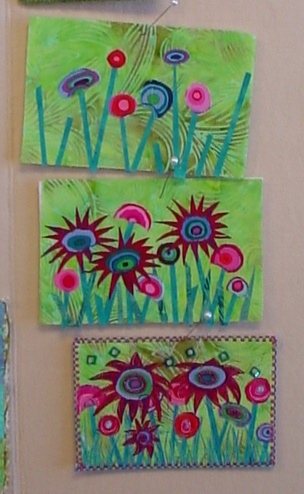 Sarah went over the layering process of constructing your card. She showed an example of the layering process of constructing a design. Once she completes a top she quilts it before she attaches the plain backing. She found it easier to address the postcard when the quilting is not through to the plain back.
Embellishments
I can’t even remember how many embellishment ideas Sarah covered. She demonstrated how to use this stuff call Angelina. It reminds me of the grass we put in Easter baskets, but much nicer. It has a metallic-opalescent quality to it. She demonstrated how you can bunch it up then using an iron and a stamp, press a design into it. Then you can trim it and use the resulting piece on you postcard. The stuff is really cool.
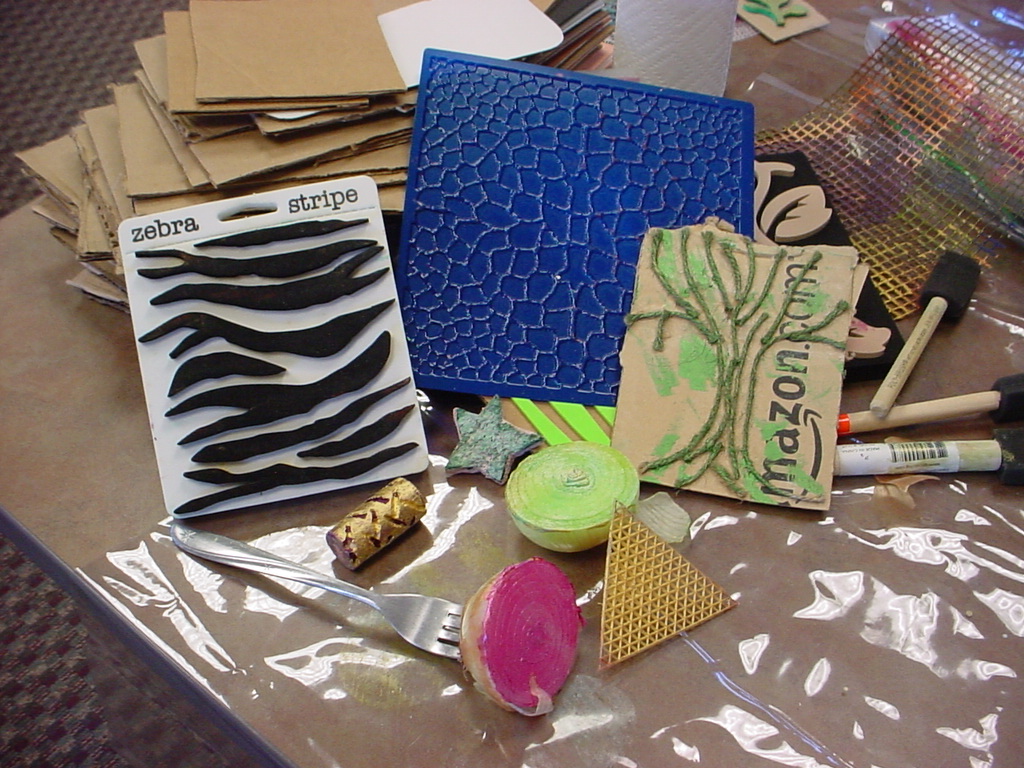 The different ideas for using paints was phenomenal. She demonstrated how to create your own stamps using carving tools and either stamping medium or a simple gum eraser. You can also use automotive gasket making material or craft foam. Another technique was using a surface that has a bumpy design of some kind. Using a roller you could paint the item then use it as a stamp to add texture to a design. She talked about creating your own stamping designs with cardboard and hot glue or twine.
You can also create a stencil from freezer paper. By cutting a design from freezer paper, then pressing it on to your fabric, there are no limits to the designs you can create. She showed us how tearing the paper can create a mountain/sky line effect or a natural looking branch. The trick with using the freezer paper is when you apply the paint, you want to brush from the paper toward the fabric. That way you will be less likely to get seepage under the stencil.
She also uses bubble wrap as a stamp. Her message is to just look at what you have. You never know how it will turn out. But she did say to test it out on your fabric first. Until you get the result you want. Then fuse it to your postcard. Because you never know how it will come out, there is no sense in ruining your postcard.
Finishing
 Once you have completed your card, you want to finish off the edges. You can use a satin or zig-zag stitch along the edge. Sarah demonstrated how to apply a decorative yarn to the edge using a three step zig-zag stitch. Sarah had various yarns to show all the possibilities. If the yarn is not heavy/thick enough to show, you can twist it with another yarn to give you enough substance to attach it to the postcard. That way you can use those pretty eyelash yarns.
Sarah also covered some of her ideas of framing/displaying her postcards. She also discussed how to mail your postcards.
Everyone enjoyed the class. There was so much information. Sarah was willing to demonstrate anything we were interested in. Here is a list of her product recommendations.
Click here to see more photos from the workshop.
If you were unable to take the class or wish to take more classes with her, check out her web site. She will be teaching at The Gathering in 2011.
Cathy H
- ← Previous
- 1
- …
- 10
- 11
- 12
- Next →
 Merrimack Valley Quilters